
Seventy-two hours is the limit that binds, and it is not the number most people quote
Three time limits govern what happens after a parcel is delivered. They are published on two different pages, they start from two different events, and nobody puts them side by side. Side by side, the shortest one is the one that decides whether your case is picked up at all.
Fragile goods are treated differently from everything else once a parcel is in transit.
Where to raise it
The contact route sits on the parcel row, not in an inbox
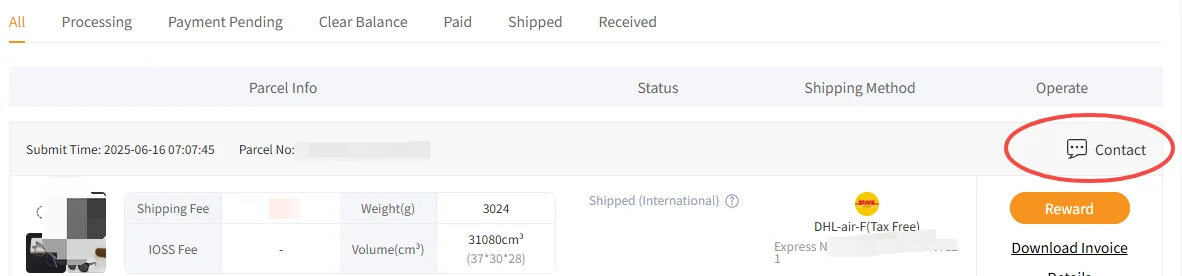
The after-sales route is short and it is not obvious: open the parcels page, find the parcel, open the order inside it, and use Apply for After-sales Service. The red ring in the official screenshot is the operator pointing at the same row, which is a fair sign that people do not find it unaided.
The form asks for two things. A detailed description of the problem, and photographs, of the outer packaging and of the goods. The outcomes it lists are refund, return and exchange, described as including but not limited to those three.
The filter strip along the top is worth a glance before you start. It runs from Processing through Payment Pending, Clear Balance, Paid and Shipped to Received, and it is the quickest way to establish which stage you are arguing about. The limits in the next section all begin at the last of those states.
Three limits, two official pages, and only one of them decides
None of the three is hidden. They are simply never printed together, and read one at a time the longest of them sounds like the rule.
| Limit | Starts when | Where it is published | What it governs |
|---|---|---|---|
| 72 hours | The courier records the parcel as delivered. | The notice on signing for a parcel. | A problem raised later than this will not be assisted. This is the one that binds. |
| Two working days | You accept delivery without opening the parcel in front of the courier, and then find damage. | The same notice. | Keep the original packaging and supply the invoice and photographs inside this window, so a claim can be put to your local postal service on your behalf. |
| Seven days | Tracking shows the parcel as delivered. | The after-sales considerations page. | Past this, after-sales support may be declined. It is the number most readers remember, and it is not the shortest one. |
The arithmetic is unkind. Somebody who has read only the after-sales page believes they have a week, and spends the first few days deciding whether the problem is worth raising. By the time they write in, the notice on the other page has already closed.
There is no conflict between the two pages to appeal to either. Both statements are true and both are published. The only safe reading is the narrow one, which is why everything else on this page assumes three days rather than seven.
A normal signature ends the transport phase for good
The signing notice asks you to do one thing before you accept a parcel: look at it for obvious differences. Where there is visible damage it asks you to inspect the contents in front of the courier and either record what you find or refuse the delivery.
The reason it asks is stated immediately afterwards. A normal signature is treated as the end of the transport process, and no transport liability is carried past that point. The signature is not an administrative formality. It is the act that closes the phase.
Which makes the thirty seconds at the door worth more than anything you can do in the following three days. A damaged box opened in front of the person who delivered it produces a record. The same box opened indoors produces a photograph of a box that was already indoors.
Two habits that pay
Deadlines here do not announce themselves
Neither of these takes any real effort. Both are impossible to reconstruct once the moment has passed.

- Deadlines
Nothing on this service waits for you
A checkout page states the minute at which an unpaid order will be cancelled. The route back to the seller closes five days after the goods are stocked. Assistance closes 72 hours after delivery.
None of these three sends a reminder. They are all published, all exact, and all enforced by simply passing.
- Evidence
Photograph the box before you open it
The after-sales form asks for photographs of the outer packaging as well as photographs of the goods. Outer packaging means the box as it arrived, with its label, its damage and its tape.
Once that box has been flattened for the recycling, half of what the form asks for no longer exists. Two photographs on the doorstep cover it.
The losses the terms say will not be compensated
This list sits at the end of the signing notice. It names one thing as covered and seven as not, and the lopsidedness is the finding. Read the short column first.
Named as compensated
- Loss of a fragile itemA fragile parcel that never arrives is treated the same as any other parcel that never arrives. This is the only outcome the list names on the paying side, and it is worth separating from the one directly opposite it.
Named as not compensated
- Damage to a fragile itemStated in the same line as the entry opposite, and stated to hold whether or not reinforced packaging was paid for.
- Dangerous goods and prohibited goods
- Natural wear, and defects in the goods themselves
- Movement in the price of the goods
- Severe weather, lightning, tsunami, earthquake and flood
- Goods out of warranty or past their expiry date
- Delay caused by weather or by customs clearance
The top pair is the one to sit with. Paying for stronger packaging changes the odds that something arrives intact; it does not change the rule about who absorbs it if the item breaks anyway. A fragile purchase carries a risk that cannot be bought off at the packing stage, and knowing that before you order is worth more than knowing it afterwards.
The rest of the right column is ordinary carrier language, and it is here so that nothing on it arrives as a surprise at the point where you are already annoyed.
Questions from the doorstep
The parcel looks damaged and the courier is still standing there.
Open it in front of them. The signing notice asks you to inspect a visibly damaged parcel in the presence of the courier and either record the damage or refuse the delivery outright. That record is worth more than any photograph you take once they have driven away.
I signed for it, and then found the damage. How long do I have?
Two working days to keep the original packaging and supply the invoice and photographs, so that a claim can be put to your local postal service on your behalf. Separately, and more importantly, a problem raised more than 72 hours after delivery will not be assisted at all.
Where do I actually file it?
From the parcels page: open the parcel, find the order, and use Apply for After-sales Service. The form asks for a detailed description of the problem plus photographs of the outer packaging and photographs of the goods. Both kinds are asked for, not one or the other.
Is the limit seven days or 72 hours?
Both numbers are published, on two different official pages. Seven days is the point after which support may be declined; 72 hours is the point after which a problem will not be assisted. Plan on 72 hours, because planning on seven days puts you four days past the limit that binds.
Can I still send it back for no reason at this stage?
No. That route closed five days after the order status turned to stored in the warehouse, well before the parcel was dispatched.