
Five days, a seller who decides, and a bill with more legs than people expect
The return badge you read before ordering and the return route you actually file through are two different things that happen to share a decision-maker. This page separates them, prices them, and lists what quietly disqualifies an item.
Conditions are written per category, and a few of them are strict enough to change what you buy.
Two different promises
The badge on the listing and the route you will actually use
The badge is real. A seven-day no-reason return on a domestic listing is a commitment the seller has made, measured from a domestic delivery to a domestic address, and it is one of the reasons that listing looks safe.
The route open to you is described separately. The official terms call the no-reason return a service provided by sellers on third-party platforms, give you five days from the moment your order status turns to stored in the warehouse to file it in your account, and state that the final decision rests with the seller.
So there are two windows with different start points, different lengths and the same person at the end of both. Reading the badge and assuming it is your window is the single most common way people discover the difference too late.

How the reason is classified decides who carries the freight
The official terms attach the bill to the reason, not to the item. Reading this before you write your reason is worth more than any amount of arguing afterwards. Rewritten from the official promised-returns terms, read 2026-09-21: the service fee is the figure the page states, while what the freight comes to depends on the route.
Classified as yours, so you carry it
- You no longer want itYou pay the outbound leg, the return leg and a service fee of 0.75 USD. The three rows below land in the same place.
- You ordered the wrong thing, or ordered too manyThe terms do not distinguish between a change of mind and a mistake.
- The international shipping quote came in over your budgetThis one catches people, because the quote arrives after the goods do.
- The seller inspects it and finds no quality problemWhere a disagreement about slight colour or about fit usually lands, and slight colour is already outside the inspection scope.
Classified as belonging to the seller
- The wrong item was sent: colour or size does not matchNormally nothing from you, unless the seller insists otherwise.
- A quality problem such as holes or stainsNormally nothing from you, unless the seller insists otherwise.
A third case belongs to neither column. Goods damaged in transit before they ever reached the warehouse are handled outside this split entirely, which is the one situation where the reason you write matters least.
One line in those terms is worth isolating. Where the seller shipped free at the time of purchase, you still pay that first leg when the return is classified as yours. Free shipping was a purchase incentive, not a standing arrangement, and it does not survive the goods going back.
Two things soften the picture. An order still showing as not shipped can be withdrawn without a charge. And the terms only charge you at all when three conditions hold together: no quality issue, the goods already stocked in the warehouse, and the free returns or exchanges for that month used up. What the page does not do anywhere is say how many that monthly allowance is, so treat it as a question to ask rather than a number to plan around.
One switch on the submit page can take the route away
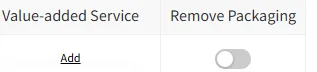
The exclusion list in the return terms includes a category phrased as goods from which the customer has asked to have the packaging, labels or accessories removed. That description matches a toggle sitting on the submit page, switched off by default, one click away from on.
Flip it and you have not just changed how the parcel is built. You have moved the item into a list the terms exclude. Whether the trade is worth making is a shipping question and this site does not price shipping; what it can tell you is what the switch costs you in options.
The rest of that exclusion list is worth reading once so it is not a surprise later: customised goods, second-hand goods, goods not sourced from the mainland, underwear, adult products, food, books in quantity, and anything already unsealed. On that page sealed means a seal applied by the manufacturer, not tape added by a seller or by the warehouse.
Before you file
Three conditions, and two very different moments to be in
Eligibility is checked against the state of the item and the state of the order. Both move without telling you.
- Eligibility
Three conditions have to hold at the same time
The terms allow a return where the seller offers a return guarantee, the item is in a condition that can be resold, and it has been in the warehouse no longer than five days.
Two of those three are decided by things that already happened, which is why the seller you picked and the way you handled the photographs both matter more than the wording of your request.
- Timing
Not shipped and already shipped are different worlds
An order still marked as not shipped can be pulled back without a charge. Once goods are stocked in the warehouse the five-day count is running and the bill in the table above applies.
Once the parcel has been dispatched, neither applies. From that point you are in after-sales, with its own route, its own evidence requirements and much less time.
Categories that carry a condition of their own
The terms attach a specific standard to fourteen categories. Eight of them are reproduced here in rewritten form, chosen because they are concrete enough to change what you do on the day the goods arrive.
| Category | Returnable only while |
|---|---|
| New sneakers | The anti-theft button, where the pair has one, and the anti-damage sticker are both still attached and still working. |
| SLRs and other cameras | The shutter has been actuated no more than twenty times. |
| Digital goods and appliances, cameras and large appliances aside | The network access licence is undamaged and there is no sign of water ingress. |
| Large appliances | A television or air conditioner has not been mounted on a wall, simple set-up aside, and a washing machine has not been run with water through it. |
| Models, figures, ball-jointed dolls and board games | Tape and shrink wrap are unopened. |
| Electronic components | Nothing has been soldered, no integrated circuit has been seated, and consumables such as thermal paste are still sealed. |
| Skincare, cosmetics, fragrance, haircare and personal paper goods | The single-use seal is intact. |
| Books and magazines | The wrapping is unopened and there are no creases, water marks, stains, ink marks or other signs of reading. |
Read together, these say one thing in eight ways: the moment to decide is before anything is opened, cut, mounted, plugged in or powered up. That is inconvenient, because opening the box is exactly how most people find out whether they want to keep something.
It is also the reason the photographs matter more here than they seem to. They are the only look you get at an item while every one of these conditions is still satisfied.
Questions about cost and eligibility
The seller shipped free. Do I really pay the first leg?
Yes, where the return is classified as yours. The terms are explicit that a seller offering free shipping at the time of purchase does not change this, and the first leg is charged back to you along with the return leg and the service fee.
How many free returns do I get each month?
The terms say a charge applies only when three things are true at once: the product has no quality issue, it is already stocked in the warehouse, and the free returns or exchanges allowed for that month have been used up.
The page never says how many that allowance is, and this site is not going to supply a number the operator has not published. If it matters to your decision, ask before you rely on it: the official return terms and the help centre.
Who actually decides whether a return goes ahead?
The seller. The terms describe the service as one provided by sellers on third-party platforms and state that the final decision rests with the seller. The agent forwards the request and applies the result.
What does an exchange cost compared with a return?
A return is charged as the outbound leg, the return leg and a service fee of 0.75 USD. An exchange is charged as the outbound leg, two return legs and the same fee, because the replacement has to travel as well.
I am past the five days. Is anything left?
Not on this route. What remains is the after-sales process that starts once the parcel has been delivered to you, and it runs on its own and considerably shorter clock.